Counterfeited in China: The Operations of Illicit Businesses
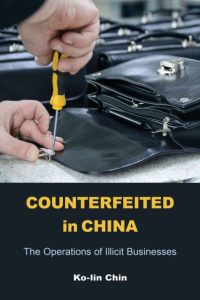 Author: Ko-Lin Chin
Publisher: Temple University Press, 2025. 304 pages.
Reviewer: Dilara Bural | Spring 2025
Product counterfeiting now dominates the world of illicit trade. The European Union Intellectual Property Office estimated that counterfeit and pirated goods reached $464 billion in 2019, representing 2.5 percent of world trade. By the late 2010s, many sources reported that counterfeiting had overtaken drug trafficking, human smuggling, and human trafficking. In 2018, estimates placed the trade’s value between $1.7 trillion and $4.5 trillion, surpassing any other form of transnational crime. Almost every country experiences its impact, yet most public and policy debates rely on seizure statistics and broad economic estimates.
This book confronts a glaring gap: researchers rarely study counterfeiters themselves in a grounded, systematic way. While policymakers debate enforcement strategies, few have walked the markets, entered the workshops, or sat in the homes of those who produce and sell counterfeit goods. This study does precisely that. The author delivers an ethnographic account of the supply side of counterfeiting, offering details that only immersive, qualitative research can reveal.
The author narrows the focus to three luxury categories—clothing, handbags, and shoes—and examines non-deceptive counterfeiting, where buyers know the products are fake. Research occurred in Guangzhou, China; additional work was done in Dongguan. Over two summers (2018 and 2019), the author interviewed 57 counterfeiters—designers, manufacturers, distributors, and facilitators—and 13 key informants, including law enforcement officers, government officials, and private investigators.
Qualitative research dominates the book’s approach. In a U.S. academic context where quantitative methods receive more prestige, this work shows the irreplaceable value of qualitative inquiry. Statistics can chart the scale of counterfeiting, but they cannot show how a counterfeit handbag moves from concept to customer, how kinship shapes trust, or how counterfeiters think about their own work. The author gained such insights by visiting homes, observing business operations, and sharing meals with participants.
The book embeds the Guangzhou trade within China’s broader economic transformation. The reform and opening up policy of the late 1970s, followed by the creation of Special Economic Zones, fostered both legitimate and illicit manufacturing. Contract manufacturing for major brands often operated alongside counterfeit production. Factory overruns, sales of non-defective extras, and producing high-quality replicas became common. By the 1990s, entire cities, such as Putian, specialized in counterfeit goods, with as many as 200,000 people involved and local authorities complicit in the trade.
The book’s thematic structure—moving from the historical development of counterfeiting to typologies, markets, and individual profiles—makes it clear and accessible. The ethnographic method provides rare insight into the everyday realities of counterfeiters, from their business practices to their self-perceptions. By centering the voices and experiences of counterfeiters, it moves beyond moral panic and simplistic narratives to reveal a complex, adaptive, and deeply embedded industry. Counterfeiting is integrated into legitimate economic structures, supply chains, and local cultures; it does not exist as a separate “underground” world.
The book’s limitations include its narrow focus on luxury goods and non-deceptive counterfeiting—leaving out large portions of the counterfeit economy, such as pharmaceuticals, electronics, and everyday consumer goods where deception plays a central role—its small, non-representative sample, and the absence of discussion on smuggling routes, given the importance of logistics in transnational crime. Even so, it delivers a depth of detail and nuance that statistical reports alone cannot provide.
For academics, it offers a rare qualitative complement to the statistical and enforcement-oriented literature. For criminology and transnational crime students, it is an accessible yet rigorous case study in how illicit economies intersect with legal structures, global supply chains, and everyday livelihoods.
The book offers a clear lesson for policymakers and professionals working in intellectual property rights: legal knowledge alone cannot produce effective policy. Understanding the culture, norms, and local political economy of counterfeiting is essential. Without this knowledge, policy will fail to match the realities on the ground.
This book is a rare and necessary contribution to the study of product counterfeiting. It shows how counterfeiters in China operate at street level, how they adapt to enforcement, and how deeply they embed themselves in local economies. Above all, it proves that the world’s largest illicit market cannot be understood—or addressed—without close, qualitative work that takes readers inside the lives and businesses of those who run it.
Dr. Dilara Bural is a Lecturer in Criminology at the University of Pennsylvania.